

Featured in “New in Setúbal”
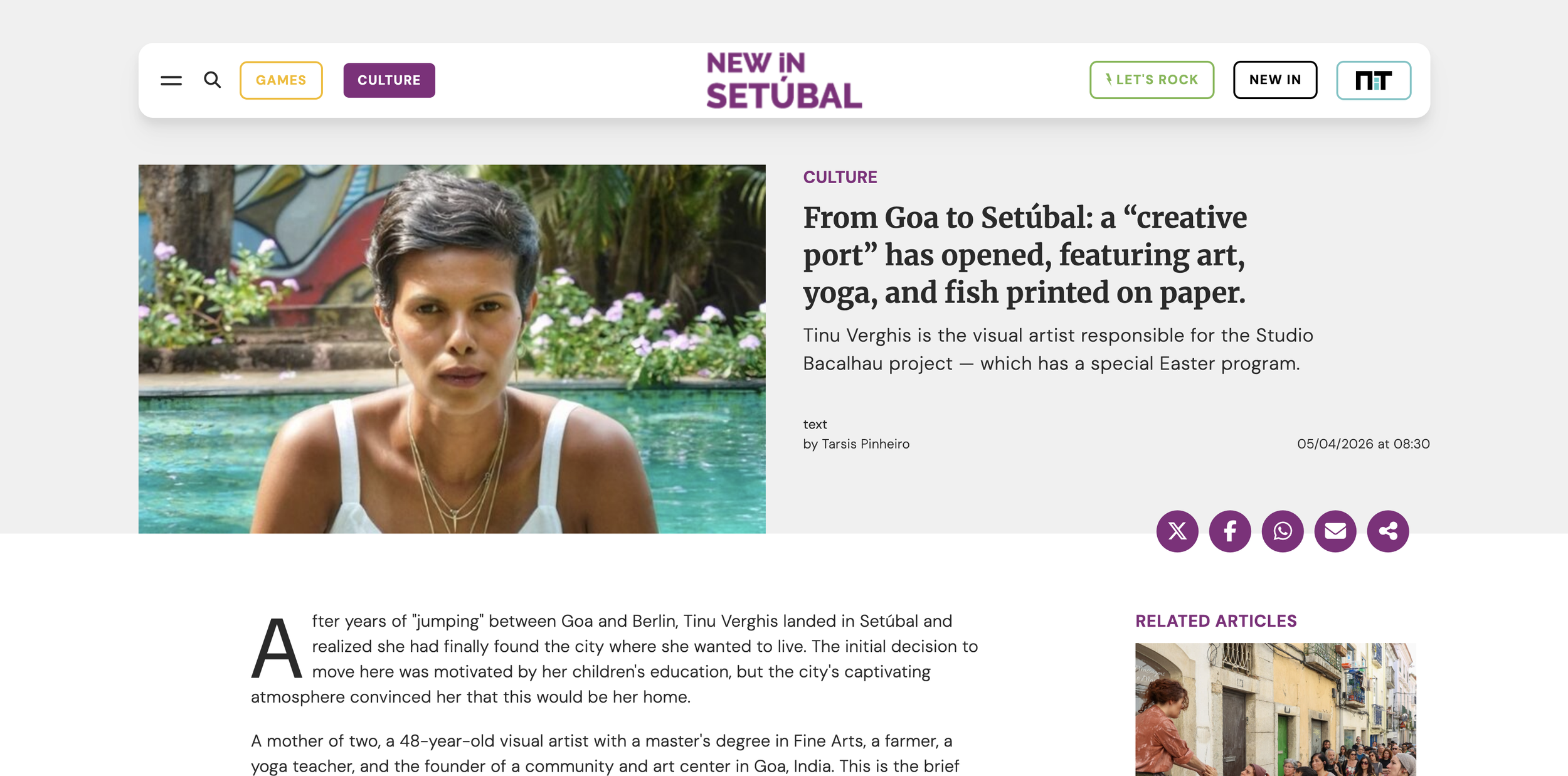
As featured in New in Setúbal
“From Goa to Setúbal: a “creative port” has opened, featuring art, yoga, and fish printed on paper.”
After years of "jumping" between Goa and Berlin, Tinu Verghis landed in Setúbal and realized she had finally found the city where she wanted to live. The initial decision to move here was motivated by her children's education, but the city's captivating atmosphere convinced her that this would be her home.
A mother of two, a 48-year-old visual artist with a master's degree in Fine Arts, a farmer, a yoga teacher, and the founder of a community and art center in Goa, India. This is the brief resume of Tinu Verghis, who arrived in Setúbal with her family exactly one year ago, accompanied by a very personal vision of how art can be born from everyday life, nature, food, and conviviality.
The result is a studio that defies a single definition. It's a creative workshop, a yoga space, a meeting place, an artistic laboratory, and a natural extension of everything Tinu was already doing on the other side of the world. Studio Bacalhau opened on February 7th and is one of the most unlikely projects of recent times.
“In Goa, art was focused on what comes from the land, on rice and agriculture; in Portugal, it’s about fish, salt and cork,” explains Tinu. The main objective of Studio Bacalhau is to show how “art intersects with the territory, with memory and with what we eat and touch every day”.
More than teaching techniques, Tinu aims to slow down the pace, get the kids away from screens, give them space to explore, experiment and fail without pressure. She wants to invite adults to live more sensory and meaningful experiences. And she also wants Setúbal to see "cod" not only as food, but as a symbol of "migration, resilience and preservation," in a kind of perfect metaphor for the very space she has just created.
An artist, farmer, and mother who found a new beginning in Setúbal.
Tinu Verghis's story doesn't begin in Setúbal, but it takes on a new meaning here. Born in India, Tinu grew up in a village where farming was a natural extension of life. "My mother grew practically everything we ate," she says. It was a rural context, where agriculture wasn't a trend or a manifesto, but simply how food got to the table. And that shaped her forever.
Later, after completing a Master's degree in Fine Arts, Tinu found a way to combine two passions that seemed to come from different universes: art and the land. She became a visual artist, but never abandoned agriculture. In Goa, she created Art Farm, a community and creative space where she hosts artists in residence for a month, in an agricultural environment free from distractions, so they can develop or continue their work. In between, she cultivates rice in its season, seasonal vegetables the rest of the year, follows permaculture principles, and cooks with what she produces.
When he moved to Setúbal last year, he didn't abandon that project. He continues to manage it remotely, maintaining similar programs and artistic residencies in Goa. But he felt he also needed to create an extension of that practice in the place where he now lives. Studio Bacalhau was born precisely from that need. Not as a break, but as a continuation.
“Art Farm and Studio Bacalhau are two expressions of the same practice,” he explains to New in Setúbal.
The move to Setúbal had a family reason behind it. Tinu was constantly "jumping" between Berlin, Germany, and Goa, India. This meant that her children attended alternative education programs. When she heard about the Luísa Todi Academy of Music and Fine Arts, she knew she had found the right place.
“We were very interested in the children learning music, and the school seemed like the perfect place for that.” They came to visit the city and were delighted. The children, aged 13 and 7, “absolutely love Setúbal,” and the mother seems to have found the ideal setting here to continue her artistic life.
Bacalhau as a symbol, metaphor, and starting point for creating
At first glance, the name Studio Bacalhau might seem unexpected for an art space. But in Tinu's universe, it makes perfect sense. "I wanted to look at cod not just as food, but as a Portuguese symbol," she explains. And it is from this deeper understanding that the studio's concept is born.
“I see cod as something that points to exchange, migration, resilience, and preservation.” In his view, it is also an image of slowness, of extended time, of transformation. All themes he was already working on in Goa, but now transported to a new territory.
This continuity between contexts is one of the most interesting aspects of the project. In India, his work arose from the land, from rice, from agriculture, from the act of sowing and harvesting. In Setúbal, the raw materials have changed, but the reasoning remains the same. Now, he is interested in fish, salt, cork, the estuary, the materials of local daily life.
This logic extends to the entire artistic practice of the space's founder. Tinu works primarily as a performance artist, but also creates installations, ceramics, and pen drawings on cork, a medium that has fascinated her precisely because it allows her to combine references from traditional Indian art forms, such as Madhubani, with Portuguese materials. Instead of the handmade paper she would use in India, she uses cork. Instead of thinking of art as something separate from life, she treats it as a direct continuation of what is touched, eaten, kept, and transmitted.
An open studio for the city, offering yoga, workshops, and experiences for children and adults.
Studio Bacalhau follows an open-plan architectural design, conceived to be flexible, welcoming, and shared. There is a specific area for yoga, with a wooden floor and a calmer atmosphere, and a large glass table where workshops and creative activities take place. Tinu wants everything there to invite presence, experimentation, and interaction with materials. Later, she also intends to organize exhibitions and invite other artists to present their work there.
Studio Bacalhau will also be offering Hatha Yoga sessions, designed for conscious movement, deep breathing, and relaxation. The classes are based on traditional principles, focusing on gentle postures, breath awareness, and mental clarity. They are aimed at both beginners and local or foreign residents seeking balance. A 45-minute yoga class costs €12. A 30-minute meditation session costs €8, and a combined yoga and meditation package on the same day costs €16.
One of the project's most original formats is called Gyotaku, a Japanese technique for printing from real fish. At Studio Bacalhau, the experience begins at the Livramento Market, where participants can buy the fish, return to the studio, and create the print on paper using natural inks and simple tools. Because the traditional ink used can be washed off, the fish is not wasted. At the end, Tinu cooks a soup and shares the meal with the participants. It's a rare intersection of art, maritime heritage, food, and conviviality. This experience costs €50 per adult and €35 per child.
There is also a very clear focus on children, something Tinu acknowledges without hesitation. "Children, when given space to explore, are magical." Perhaps because she is a mother of two, perhaps because she understands how childhood is becoming increasingly fast-paced and dominated by visual stimulation and screens, the studio has also become a place designed for them.
Every afternoon, between 4 pm and 5 pm, there's an Open Studio for kids, costing €6 per child per hour. In this format, they can freely explore the space, materials, and creative possibilities. Then, between 5 pm and 6 pm, the Creative Hour begins, costing €12, where they learn something new, from making jewelry and printing to creating sculptures, dolls, or small craft projects.
A space where the process matters more than the result.
If there's one idea that runs through all of Studio Bacalhau, it's that creating doesn't have to mean producing something perfect. In her work with children, this is particularly evident. Tinu uses cork, clay, printing techniques, and natural materials to stimulate curiosity, imagination, and a connection with the physical world. But she rejects the logic of obligatory results.
“There is no predetermined outcome when I run workshops for children. It’s all about the process.” The goal is not to leave with a “beautiful” or “finished” piece, but with a lived experience.
This philosophy is, fundamentally, a form of resistance to the accelerated pace at which everything happens today. "I want to slow down the way children engage with life."
From his perspective, the constant interaction with digital media pushes everything forward, without time for digestion, contemplation, or real contact with the materials. In the studio, Tinu wants precisely the opposite: to touch, to feel, to observe, to make mistakes, and to start again.
In adults, the logic remains the same, albeit with other layers. The experiences are equally sensory and experiential, but seek to create meaningful connections between people, food, territory, and memory.
Gyotaku is a clear example of this. However, Tinu wants to go further, developing activities around yoga, shared meals, and encounters between strangers who get to know each other through doing, with various workshops. Community and care, she says, are at the heart of her practice.
That's why he defines Studio Bacalhau as a "creative haven." A place where everyday materials, local culture, food, artistic practice, and human interaction meet. It's not just a studio to learn a technique or fill an hour. It's a space designed for those seeking slower, more tactile, more present experiences. And perhaps that's precisely what makes it so unique in a city where there's still so much to explore in terms of art, territory, and community.
Special programs, artist residencies, and a future yet to be built.
Although the studio has only recently opened, the programming has already begun to take shape. Tinu is developing workshops for children and adults, seasonal programs, and wants to continue expanding its offerings over the coming months. The model remains intimate and small-scale: activities operate with a minimum of three and a maximum of eight participants, which allows for preserving the closeness and quality of the experience.
Now, with the school holidays in mind, Studio Bacalhau has also prepared an Easter Camp fully aligned with its "slow art" philosophy, with two weeks of programming (from March 30th to April 3rd and from April 6th to 10th) aimed at children aged 7 to 12.
Each day brings a different experience, always linked to nature and materials: on Mondays there's Gyotaku, the Japanese technique of printing with fish and natural pigments; on Tuesdays, the focus is on cork, with the creation of pieces and collages from natural textures; on Wednesdays, the children explore clay, salt and earth pigments in a sensory approach to sculpture; and on Thursdays they enter a playful universe with the creation of masks inspired by rabbits and foxes. On Fridays, the cycle closes with a mini-exhibition and open workshop, where they can share what they have created.
The program also includes a structured daily routine, with yoga at 10:00 AM, art sessions between 10:30 AM and 12:30 PM and again between 1:30 PM and 3:00 PM (with a lunch break in between), reinforcing the balance between creative expression and well-being. The cost is €35 per day, with snacks included (lunch is brought by the children), in an environment designed to stimulate curiosity, connection with nature, and authentic artistic experiences, always away from the fast pace of life and screens.
Another important aspect is artistic residencies. Just as in Goa, Tinu wants Studio Bacalhau to host guest artists. The first theme has already been launched: “Salty”. The proposal invites artists to respond to the processes of drying, curing, storing, and remembering, using cod as a conceptual and symbolic starting point.
"Bacalhau is never fresh; what does it mean to carry that idea in the body, in language, or in the land?" It's a beautiful and strange question, like everything that's truly worth exploring artistically.
Furthermore, on Fridays, the space will transform into a small, intimate cinema, offering free screenings of independent films, including short and feature-length films, designed to provoke thought, raise questions, and spark conversation. Entry will be free , and the goal is the same as everything else: to bring people together around cultural experiences that are usually marginalized.
Credit: This article appeared in New in Setubal on 05/04/2026 by Tarsis Pinheiro
Original language: Portuguese
